
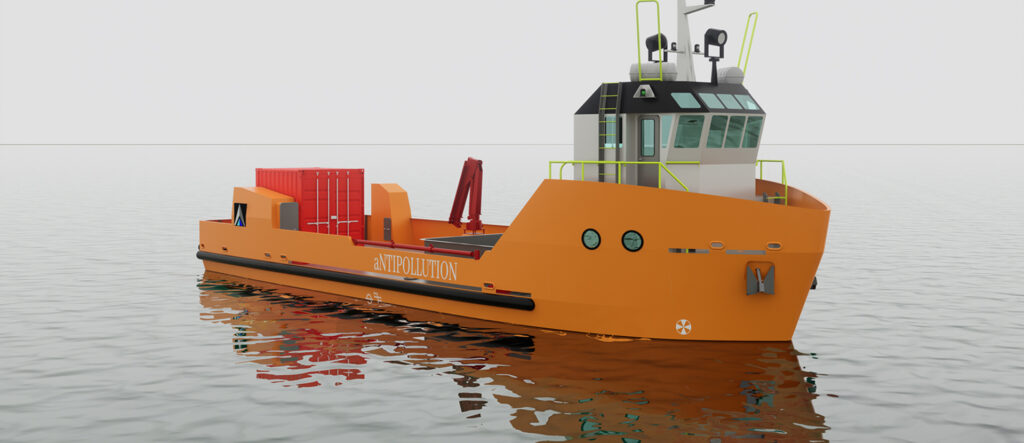
Hybrid Electric Propulsion
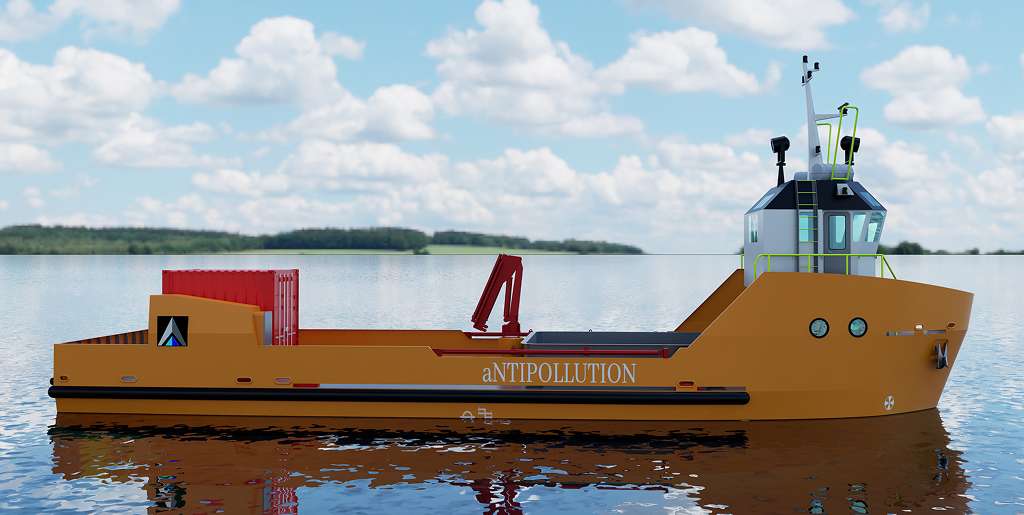
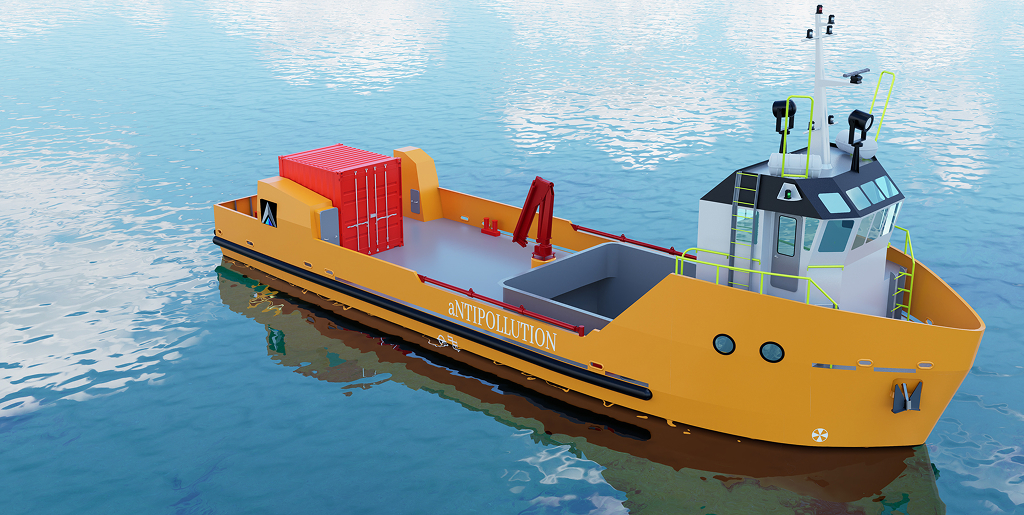
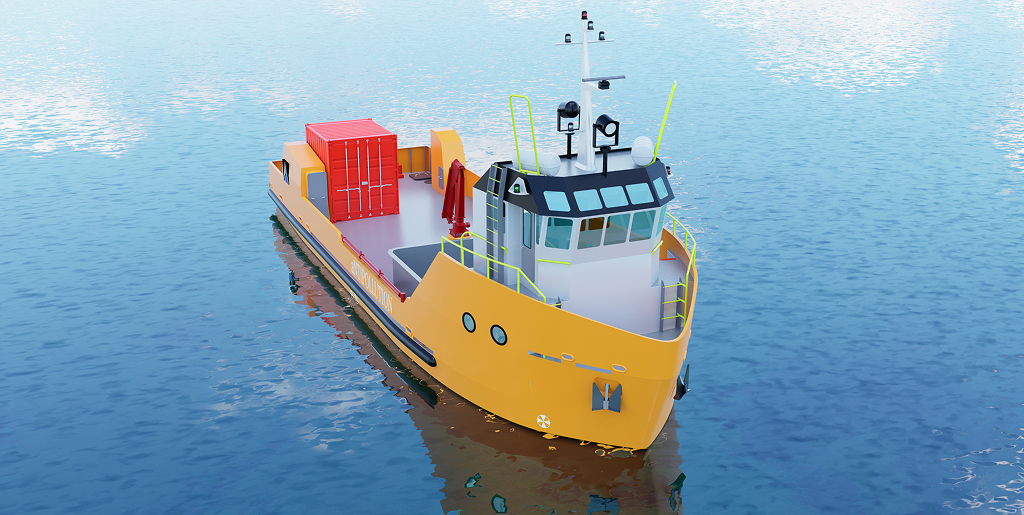
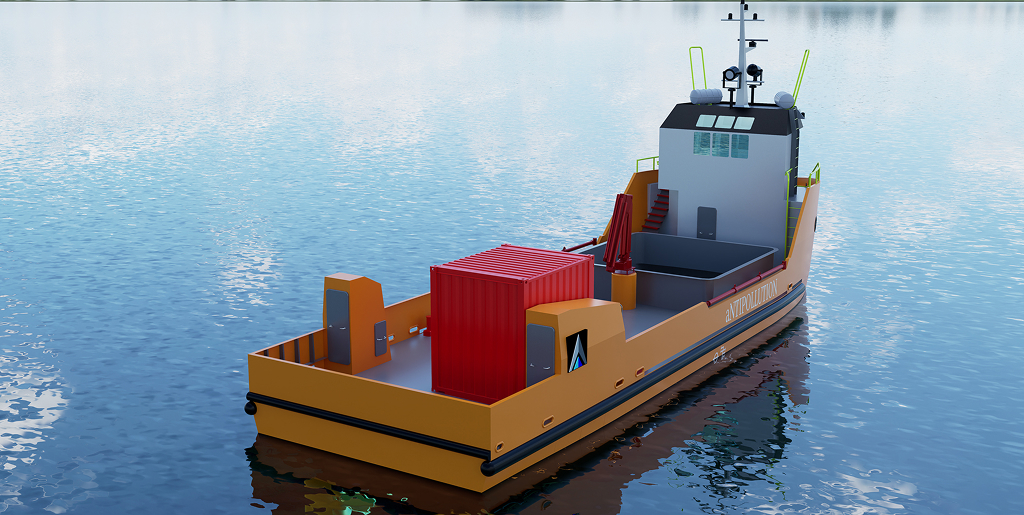
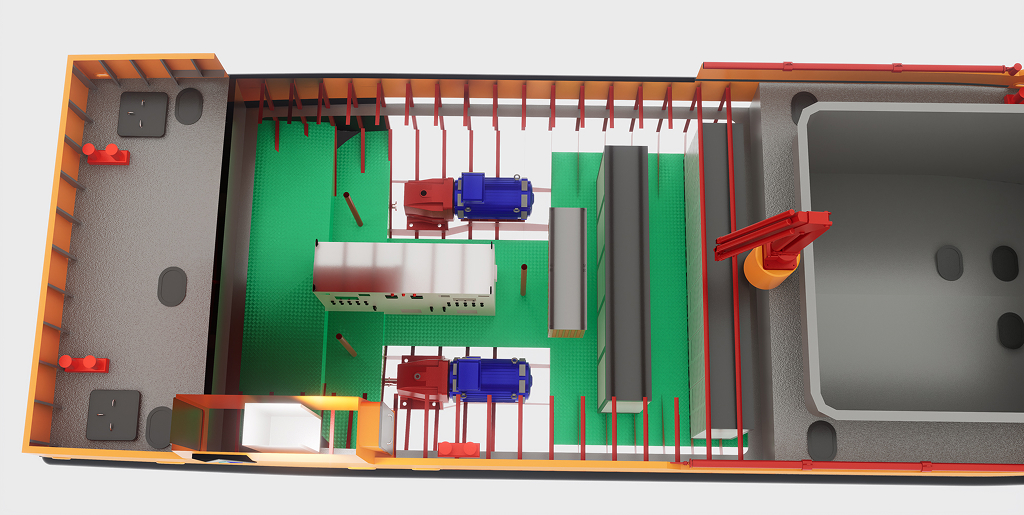
Clean Energy Integration Without Compromising Operational Readiness.
THe challenge
How do you integrate a fully electric propulsion system into a working anti-pollution vessel without compromising its operational capability, response readiness, or deck functionality?
Anti-pollution vessels operate in some of the most demanding maritime environments. They must be capable of rapid deployment, extended on-site endurance, and continuous operation in environmentally sensitive areas. At the same time, increasingly stringent emission regulations are driving the transition toward cleaner vessel technologies.
The challenge was clear: develop a propulsion solution that significantly reduces emissions while preserving the vessel’s pollution response capabilities, operational flexibility, and safety standards.


The Engineering Solution
For this project, AURELIA developed a fully electric propulsion concept that eliminates conventional main diesel engines entirely.
The vessel is powered by fixed-pitch propellers driven directly by electric motors through a shaft and gearbox arrangement. Energy is supplied primarily by high-capacity battery banks, supported by generator sets and shore charging infrastructure. The result is a highly efficient propulsion architecture designed around the vessel’s real operational profile rather than traditional machinery arrangements.
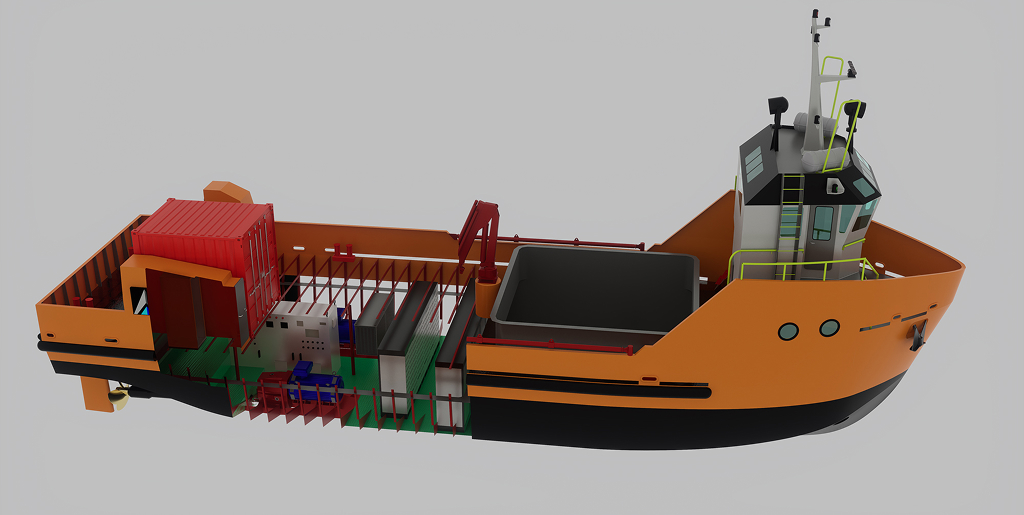
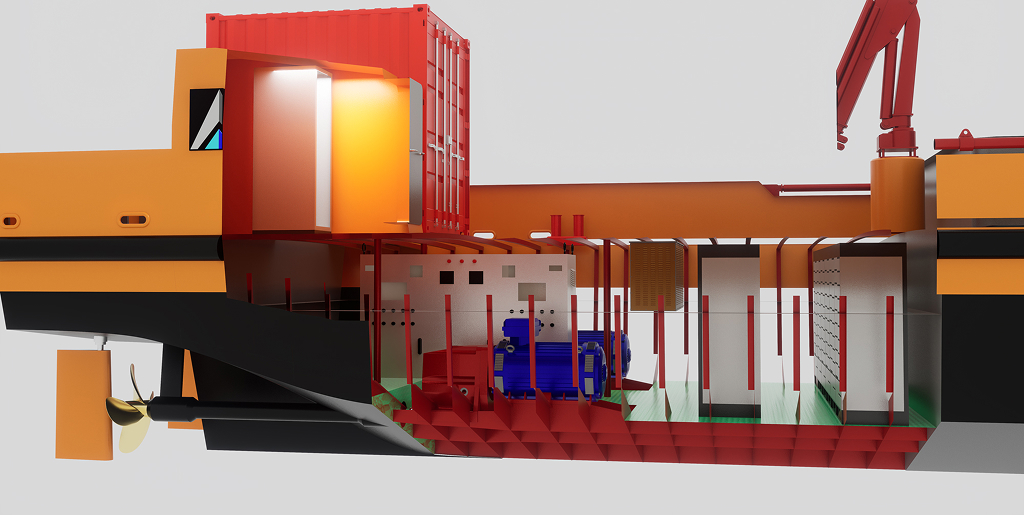
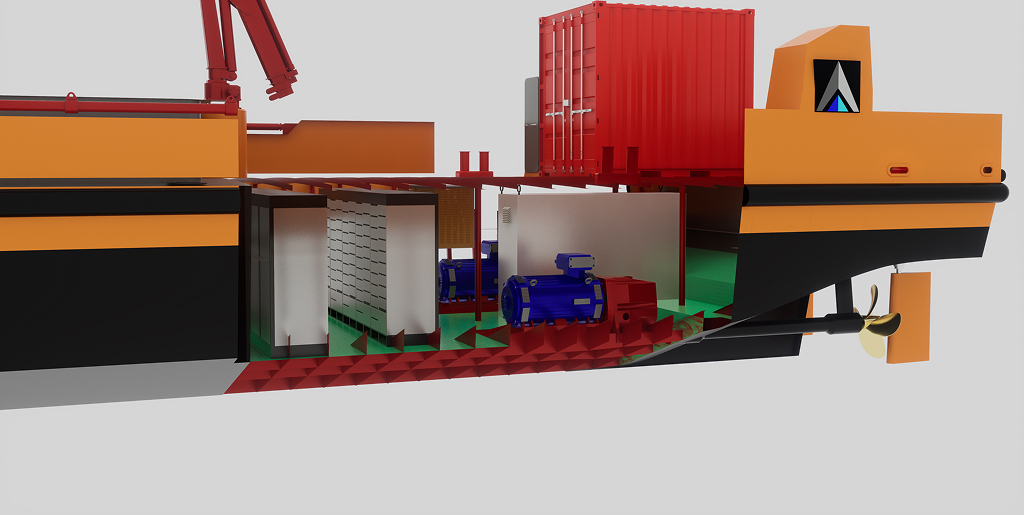
To accommodate the new system, the engine room layout was re-engineered. The forward bulkhead was relocated to create additional machinery space for electric motors, frequency converters, battery banks, transformers, and the main switchboard. This integration was achieved without affecting the vessel’s recovery tank capacity or deck operations.
The design maintains full operational capability while creating a platform ready for future sustainability requirements.
Electrical Propulsion Integration
The propulsion system is built around electric drive technology that delivers reliable performance while simplifying mechanical complexity.
Two electric motors are connected to fixed-pitch propellers through a conventional shaft and gearbox arrangement, providing efficient propulsion and precise control during both transit and pollution response operations.
The vessel’s primary energy source consists of two battery banks with a combined capacity of 1,480 kWh. Under typical operational conditions, the batteries provide up to three days of endurance at a continuous 60 kW load.
When the vessel returns to port, the batteries can be fully recharged through a dedicated shore connection, enabling zero-emission operation during normal deployment cycles.
Smart energy management
At the heart of the system is an integrated energy management architecture
designed to maximize efficiency, reliability, and operational readiness.
Smart Battery Management System
A dedicated Battery Management System (BMS) continuously monitors cell-level performance, optimizes charging and discharging cycles, and protects battery integrity under varying operating conditions.
The system automatically manages transitions between shore power, battery operation, and generator support without interrupting vessel availability.
Dynamic Load Balancing
The energy management platform continuously distributes power between propulsion and auxiliary consumers based on operational demand.
Whether the vessel is transiting, conducting recovery operations, or standing by in port, available energy is allocated efficiently to maintain optimal performance while minimizing energy losses.
Built-In Redundancy
Operational reliability is supported through a redundant power architecture.
Two generator sets of approximately 600 kW each provide backup power generation capability, while an additional 80 kW auxiliary generator supports port operations and essential consumers. A dedicated emergency generator, installed within a weather-deck containerized unit, ensures critical systems remain operational under all circumstances.
Supporting Pollution Response Operations
The propulsion upgrade was carefully integrated with the vessel’s primary mission as an anti-pollution platform.
The vessel retains its substantial recovery capacity, including an 88 m³ main recovery tank and additional storage tanks positioned throughout the hull. A dedicated pump room supports efficient recovery operations, while deck equipment arrangements were optimized to maintain unobstructed working areas and operational flexibility.
By removing conventional main engines and introducing a modern electric power architecture, the vessel can conduct pollution response activities with significantly lower environmental impact while maintaining the endurance and reliability required for emergency operations.
Why it matters
Anti-pollution vessels are designed to protect the marine environment. Reducing the vessel’s own emissions is therefore a logical next step in advancing that mission.
This project demonstrates that large-scale electrification is no longer a future concept. Through careful engineering, high-capacity energy storage, and intelligent power management, AURELIA has developed a practical and deployable solution that combines environmental responsibility with operational performance.
The result is a cleaner, quieter, and more efficient vessel that remains fully capable of meeting the demanding requirements of modern pollution response operations.
At AURELIA, we focus on engineering solutions that work in real-world maritime environments.


| MAIN DIMENSIONS | |
|---|---|
| Type of vessel | Anti-Pollution Vessel |
| Length over all +/- | 23.90 M |
| Breadth (moulded) | 6.60 m |
| Depth to main deck | 3.18 M |
| Draught | 2.40 |
| Pollution Response Capacity | |
|---|---|
| Main Recovery Tank | 88 m³ |
| Additional Tank Capacity | 9.5 + 11.0 + 9.5 m³ |
| Pump Room | Dedicated, Below Main Deck |
| Crane Arrangement | Repositioned Forward |
| Full Vessel | (EXC. Hatch Cover #3 due to helicopter) |
|---|---|
| Propulsion Type | Fully Electric, Fixed Pitch Propellers |
| Primary Energy Source | Battery Energy Storage System |
| Battery Capacity | 2 × 740 kWh |
| Total Energy Storage 1,480 kWh | 258kwp |
| Endurance | Up to 3 days at 60 kW continuous load |
| Charging Method | Shore Connection |
| Transformers | 2 × 100 kVA |
| Emergency Generator | 10 ft Containerized Unit |