
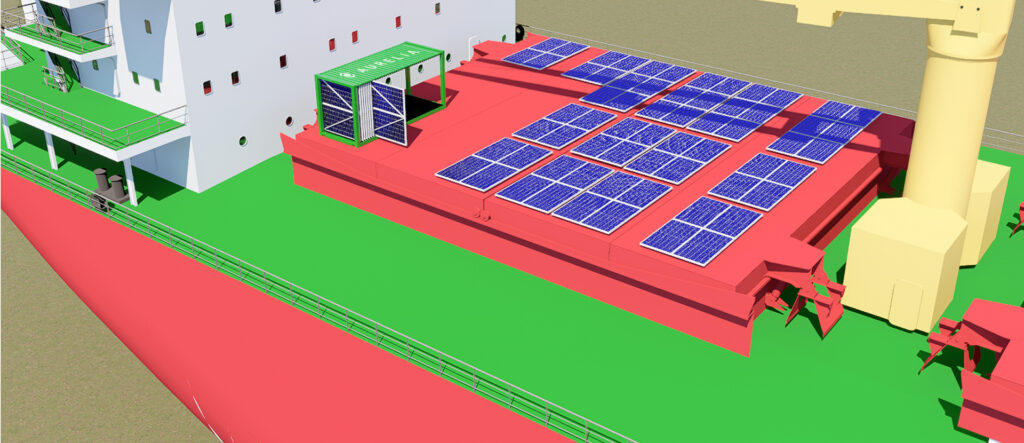
Solar Integration for Maritime Operations
At AURELIA, we believe renewable energy at sea should be practical, safe, and operationally intelligent.
This project demonstrates how solar power can be integrated into working vessels without compromising cargo operations, safety, or stability.
The challenge
How do you install large-scale solar capacity on hatch covers that must remain fully operational?
Each solar panel weighs 36.5 kg. Handling them individually offshore would increase operational risk and time. At the same time, the vessel’s hatch covers must remain accessible for cargo operations, and stability impact must remain negligible.

Our Engineering Approach
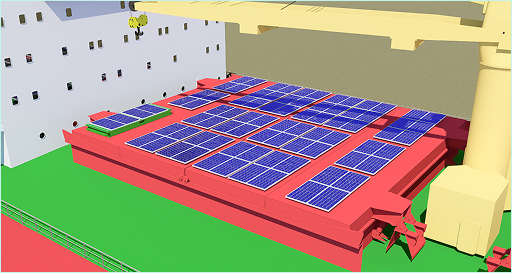
Scalability is central to the system design. The modular frame concept allows solar capacity to be adjusted to the available deck area and the vessel’s energy demand. Standardized frames can be added progressively, enabling expansion without major structural modifications or operational disruption.
Pre-assembling panels into two-panel frames ensures consistent quality, reduces installation time, and minimizes handling risks. The modular configuration simplifies logistics, improves efficiency, and allows seamless integration of additional frames.
Technical configuration:
- Panels assembled in frames of two
- Frame dimensions: 2.60 × 2.38 m
- Frame weight: 73 kg
- 42 frames per 20 ft High Cube open-frame container
- Total container load: approximately 3 tons (excluding container weight)
The system is engineered to operate with the vessel’s own cranes, requiring only two crane movements for complete handling operations.

Smart Handling Concepts
To ensure safe and flexible operations, we developed two handling approaches:
Deck-Based Container Handling
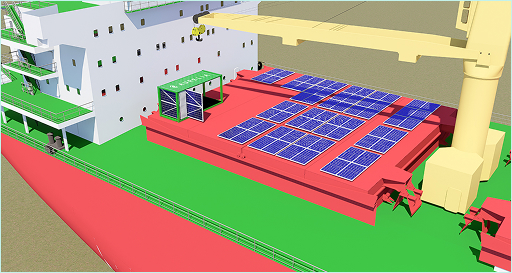
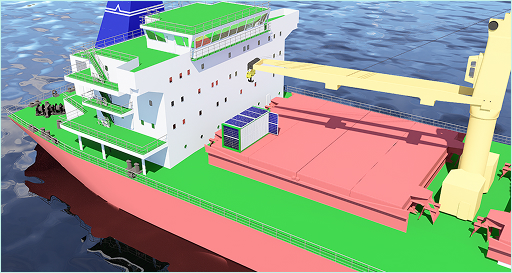
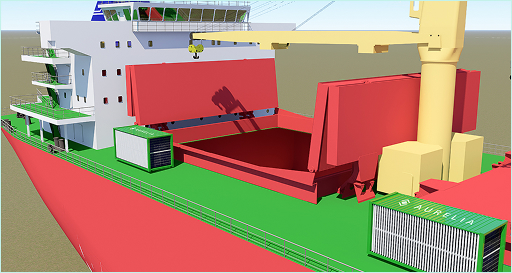
The container remains on the main deck during navigation. When installation is required, it is lifted onto the hatch cover using the ship’s crane, and the frames are installed directly from the container. After completion, the container is lowered back to deck level for greater safety, ensuring that normal hatch operations can resume. The panels will not be installed when it is necessary to operate, open, or close the hatch covers.
Foldable Hatch-Top Unit
For owners preferring not to keep a 20 ft container on deck once panels are deployed, we designed a foldable container solution.
This unit sits on top of the hatch cover and includes integrated frames on its roof. When retrieval is required, the container is assembled via crane lift, ensuring safe and controlled handling.
Both solutions minimize crane use, reduce crew risk, and maintain operational flexibility.
Why it matters
This project shows that solar at sea does not need to be experimental or disruptive. With intelligent frame design, smart containerization, and operationally aligned handling procedures, renewable integration becomes practical, scalable, and safe.
At AURELIA, we focus on engineering solutions that work in real-world maritime environments.

| MAIN DIMENSIONS | |
|---|---|
| Type of vessel | Bulk Carrier |
| Length Overall | 189.99M |
| Breadth (moulded) | 32.26M |
| Depth (moulded) | 18M |
| Draught | 7.20M |
| Speed | 14.2KN |
| MAIN DIMENSIONS | |
|---|---|
| Frames per hatch | 42 |
| Total frames | 336 |
| Solar panels | 672 |
| Peak power (64kwp per hatch) | 258kwp |
| Total weight | +30 Tons |
| CoG impact | negligible |